

Most people know what a “will” is — it’s the document read aloud in every family drama on TV. But another tool quietly does more of the heavy lifting: the “living trust.”
Are you a Muslim living in the U.S.? Do you own a home, a retirement account, or a business? Do you have children? Then a living trust deserves a serious look. Yet fewer than a quarter of Americans have even a will, and more than half have no estate planning documents at all [3].
Here’s what a living trust is, how it works, and how it can help your family follow the Fara’id in Washington, Oregon, Virginia, and Arizona.
What Is a Living Trust?
But first: what is a trust? A “trust” is a legal arrangement where one person holds and manages property for the benefit of someone else.
A living trust is a trust you create during your lifetime. While you’re alive, you usually act as the “trustee” (the person managing the trust) yourself. If you pass away or can’t manage your affairs, a “successor trustee” you’ve chosen steps in and follows your written instructions [1].
Most living trusts are “revocable.” You can amend the trust, take property back out, or cancel it entirely [2]. An “irrevocable” trust, on the other hand, generally can’t be changed — it’s used mainly for specific tax or asset-protection goals [1].
Who’s Who in a Living Trust
| Role | Who it is | What they do |
|---|---|---|
| Grantor | You | Creates the trust and sets the rules |
| Trustee | Usually you, during your lifetime | Manages the trust’s assets |
| Successor trustee | A spouse, adult child, or professional | Takes over at incapacity or death |
| Beneficiaries | You, then your heirs, a charity, or a masjid | Receive the benefit of the property |
How Does a Living Trust Work? Step by Step
- Sign the trust document. An attorney drafts it to fit your goals and your state’s law.
- Fund the trust. You retitle assets into the trust’s name — for example, by recording a new deed for your home and retitling bank accounts [10].
- Live as usual. As trustee, you manage your property just as you did before.
- If you become incapacitated, your successor trustee can manage trust assets, usually without going to court.
- After your death, the trust becomes irrevocable. Your successor trustee pays debts and expenses, then distributes what’s left exactly as the trust directs, often without probate [1].
As we’ve mentioned, step two is the one people skip. Think of it this way: signing the trust builds a safe. Funding puts your valuables inside. An empty safe protects nothing.
Retirement accounts usually pass by beneficiary designation instead, and a “pour-over will” sends anything you forgot into the trust [11].
Living Trust vs. Will: What’s the Difference?
| Will | Revocable living trust | |
|---|---|---|
| Takes effect | Only at death | Once signed and funded |
| Goes through probate? | Yes | Funded assets generally do not |
| Privacy | Public once filed with the court | Generally private |
| Covers incapacity? | No | Yes |
| Names guardians for minor children? | Yes | No [11] |
| Upfront cost and effort | Lower | Higher |
So which do you need? In most cases, both. (For a deeper comparison, see our article “Estate Planning: Will vs. Trust (And Why a Trust Almost Always Wins)”.)
The Trade-Offs
A living trust costs more upfront than a will, and funding takes effort. It won’t shield assets from creditors while you’re alive or cut estate taxes on its own — the assets are still treated as yours [11].
But an effort to save time now often costs time, money, and hardship for your family later.
Living Trust Basics in Washington, Oregon, Virginia, and Arizona
| State | What to know |
|---|---|
| Washington | A “community property” state (property earned during marriage generally belongs to both spouses); a spouse can’t leave more than half of it by will [8]. The state estate tax exclusion is $3 million for deaths on or after July 1, 2026, with rates from 10% to 20% [5]. |
| Oregon | The estate tax applies to estates of $1 million or more — one of the lowest thresholds in the country [6]. A 2026 bill to raise it failed [12], and reform proposals come up often, so check current law. |
| Virginia | No estate tax, but a probate tax of 10 cents per $100 on estates over $15,000 [7]. Funded trust assets generally pass outside probate. |
| Arizona | Also a community property state [9]. |
The federal exemption is $15 million per person in 2026 [4], so state rules matter more for most families.
Can a Living Trust Follow Islamic Inheritance Law?
The important question: can a U.S. living trust carry out the Fara’id? Yes — but only if it’s drafted correctly.
In Islam, inheritance follows the “Fara’id” or “Mawarith” (the shares Allah (SWT) set out in the Qur’an).
“For men is a share of what the parents and close relatives leave, and for women is a share of what the parents and close relatives leave, be it little or much – an obligatory share.”
— Surah An-Nisa 4:7
Just because you haven’t made an estate plan, it doesn’t mean you don’t have one. Without a plan, your state’s “intestacy” rules (default inheritance laws) decide who inherits — and those shares rarely match the Fara’id. A living trust writes the Islamic shares into a binding legal document. (See “What Happens if a Muslim Dies without a Will in Virginia (Or Any State)?”.)
A trust can also include an “Al-Wasiyyah” (bequest) of up to 1/3 of your estate, after funeral costs and debts, for a masjid, a charity, or someone who isn’t an heir — a beautiful way to leave Sadaqa Jariyah (ongoing charity). It can’t go to someone who already inherits:
“Allah has appointed for everyone who has a right what is due to him, and no bequest must be made to an heir.”
— Sunan Abi Dawud 2870
Worked Example: The Rahman Family
Take this example: Yusuf Rahman passes away, leaving his wife, Maryam, two sons, Ibrahim and Adam, and a daughter, Aisha. None of his parents or grandparents are living. After his debts and funeral costs are paid, his trust distributes his estate under the Fara’id:
| Heir | Relationship | Share | Percentage |
|---|---|---|---|
| Maryam | Wife | 1/8 (because there are children) | 12.5% |
| Ibrahim | Son | 2 of 5 residue parts | 35% |
| Adam | Son | 2 of 5 residue parts | 35% |
| Aisha | Daughter | 1 of 5 residue parts | 17.5% |
| Total | 100% |
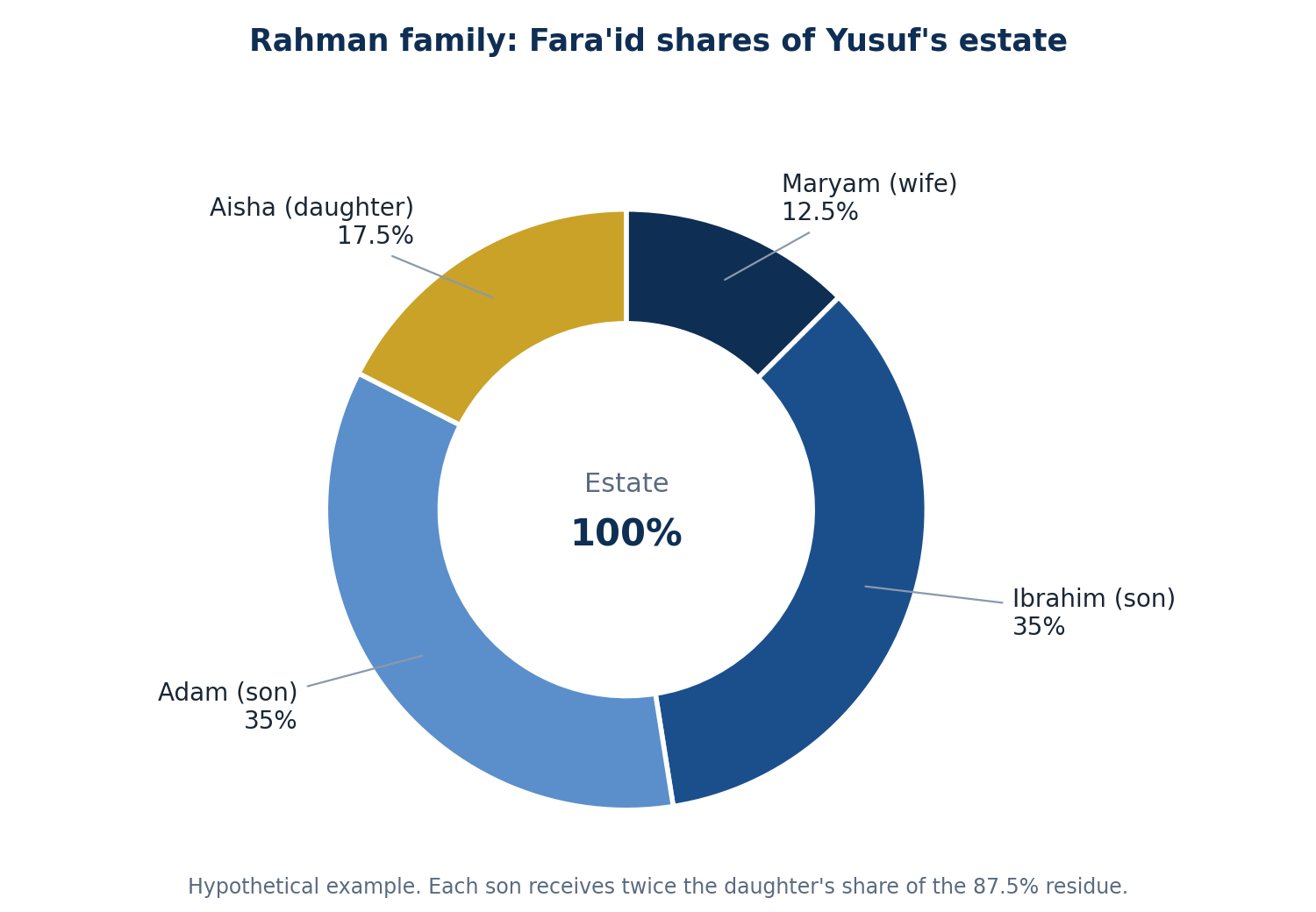
Here’s why: Maryam receives 1/8 because Yusuf left children. The remaining 87.5% is split into five parts of 17.5%, with each son receiving twice a daughter’s share.
This example is hypothetical; shares change with births, deaths, marriages, and which relatives survive. In Washington and Arizona, community property adds one more layer: each spouse’s trust can typically direct only that spouse’s share [8][9], so both spouses should plan together.
Common Mistakes to Avoid
- Never funding the trust, or forgetting to add property bought later.
- Using a generic online template that ignores your state’s law or the Fara’id.
- Skipping the pour-over will, leaving no guardian named for your children.
- Never updating it after a marriage, birth, death, or move.
Living Trust FAQs
Do I still need a will if I have a living trust?
Yes! A trust can’t name guardians for minor children, and it only controls assets placed in it. A pour-over will fills both gaps.
Does a living trust avoid probate?
Yes, but only for assets properly titled in the trust’s name. Anything left in your individual name, with no beneficiary designation, may still need probate.
Can I be the trustee of my own living trust?
Yes, and most people are. You manage everything as before and name a successor trustee to step in later.
Does a living trust protect my assets from creditors?
Not while you’re alive, in most cases. Because you keep full control of a revocable trust, its assets are still treated as yours.
Can a living trust follow Islamic inheritance law?
Yes, if drafted correctly. It can follow the Fara’id and include an Al-Wasiyyah of up to 1/3 for non-heirs or charity. (Learn more in “Islamic Wills & Trusts — Sharia-Compliant Estate Planning by a Licensed Attorney”.)
Start Somewhere
Estate planning can be intimidating if you don’t know where to start. The important thing is that you start somewhere. A living trust can be updated over time as your family, your assets, and your relationships change.
Our firm has helped Muslim families in Washington, Oregon, Virginia, and Arizona build Shariah-compliant estate plans for more than 20 years. Protect your family and fulfill the Fara’id.
This article is general information, not legal advice. Laws change, so please consult an attorney about your situation.
References
- American Bar Association. “What is a Revocable Living Trust?” n.d. https://www.americanbar.org/groups/real_property_trust_estate/resources/estate_planning/revocable_trusts/
- Legal Information Institute, Cornell Law School. “Revocable living trust” (Wex). Last reviewed 2021. https://www.law.cornell.edu/wex/revocable_living_trust
- Caring.com. “Worst States to Die Without a Will” (reporting the 2025 Wills and Estate Planning Study). Updated 2026. https://www.caring.com/resources/worst-states-to-die-without-a-will-2025
- Internal Revenue Service. “IRS releases tax inflation adjustments for tax year 2026, including amendments from the One, Big, Beautiful Bill.” 2025. https://www.irs.gov/newsroom/irs-releases-tax-inflation-adjustments-for-tax-year-2026-including-amendments-from-the-one-big-beautiful-bill
- Washington State Legislature. “Final Bill Report, ESB 6347 (C 209 L 26).” 2026. https://lawfilesext.leg.wa.gov/biennium/2025-26/Pdf/Bill%20Reports/Senate/6347.E%20SBR%20FBR%2026.pdf
- Willamette Week / Oregon Journalism Project. “As State Lawmakers Ponder Federal Funding Cuts, Initiative Advances That Would End Estate Tax.” 2025. https://www.wweek.com/news/state/2025/10/07/as-state-lawmakers-ponder-federal-funding-cuts-initiative-advances-that-would-end-estate-tax/
- Code of Virginia. “§ 58.1-1712. Levy; rate of tax.” Virginia Legislative Information System, accessed 2026. https://law.lis.virginia.gov/vacode/58.1-1712
- Washington State Legislature. “RCW 26.16.030: Community property defined—Management and control.” Certified 2023. https://lawfilesext.leg.wa.gov/Law/RCWPDF/RCW%20%2026%20%20TITLE/RCW%20%2026%20.%2016%20%20CHAPTER/RCW%20%2026%20.%2016%20.030.pdf
- Arizona State Legislature. “A.R.S. § 25-211: Property acquired during marriage as community property.” Accessed 2026. https://azleg.gov/ars/25/00211.htm
- New York City Bar Association. “Living Trusts—Revocable & Irrevocable.” n.d. https://www.nycbar.org/get-legal-help/article/wills-trusts-and-elder-law/trusts/living-trusts-revocable-irrevocable/
- NerdWallet. “Revocable Living Trust: Definition, How Living Trusts Work.” n.d. https://www.nerdwallet.com/article/investing/estate-planning/revocable-living-trust
- The Eastern Progress (via States Newsroom). “Oregon lawmakers preview Kotek’s prosperity council findings amid economic ’inflection point’.” 2026. https://www.easternprogress.com/oregon-lawmakers-preview-kotek-s-prosperity-council-findings-amid-economic-inflection-point/article_2c55e24d-6c25-5b75-b918-e9598704a136.html
One response to “What Is a Living Trust and How Does It Work?”
[…] What Is a Living Trust and How Does It Work? […]